Charles Manson Made Music and Art and Sold It
It's the 50th anniversary of the serial killer'southward debut album 'Prevarication: The Love and Terror Cult'.
We're taking a rather dissimilar arroyo to our 'Album of the Week' feature this calendar week as we explore instead the power that series killer and cult leader Charles Manson had on musical culture on this, the 50th anniversary of his album Lie: The Love and Terror Cult which was recorded between 1967 and 1969 and released during his trial in 1970. While in that location's arguably nothing especially remarkable about the album to notation in terms of musical dexterity - at best, it'southward a mediocre folk tape with disjointed lyrical themes - it does accept a cult following thanks to the macabre history surrounding it. Artists like The Brian Jonestown Massacre and Neil Young are purported fans of the album, though whether they would yet be if Manson hadn't incited his followers to commit nine murders during the summer of 1969 is another question. Lie: The Love and Terror Cult Prevarication: The Honey and Terror Cult was produced past Phil Kaufman (who has his ain disturbing history) through Awareness Records afterwards he met Manson in prison house, before the Manson Family cult was formed. Kaufman allegedly thought Manson'due south guitar playing wasn't up to much, simply appreciated his singing and songwriting abilities enough that he gave him the contact details for Gary Stromberg at Universal. The subsequent recording session was a failure because Manson'southward arroyo was unprepared and amateurish, and though Kaufman would produce it in the end, it would reportedly only go on to sell 300 copies, though 2,000 were distributed. Kaufman even lived with the Manson Family for a time, merely he chop-chop grew apart from Manson because - while he enjoyed sexual relationships with many of the women in the cult - he was never interested in being one of Manson's followers. The title of the record and the mugshot on the cover parodies the Life magazine cover from December 1969 which featured "The Dearest and Terror Cult" equally a headline. The "F" was, admittedly rather cleverly, removed from the word "Life". While Manson was in custody, it is claimed that he was then desperate for people to hear his music that he chosen Kaufman about it five times a week. Manson's musical venture came out of a chance friendship with the Beach Boys' Dennis Wilson in 1968. Dennis wanted him to exist signed under the ring's Brother Records, but Brian Wilson refused. He and Carl Wilson, however, did co-produce several recordings of Manson's music at Brian'due south home studio, though these are likely to never be released to the public. Of course, information technology is possible that some songs were re-recorded for Lie: The Beloved and Terror Cult merely this has never been confirmed. The Embankment Boys went on to tape one of Manson's songs, Cease to Be, nether the championship Never Learn Not to Love (a line in the original song), though they refused to credit Manson attributable to an outstanding debt. This, coupled with the changes in lyrics ("terminate to exist" being changed to "cease to resist") understandably bellyaching Manson, but he agreed to renounce his credit under a budgetary arrangement. The vocal was included on the Embankment Boys' album twenty/20, released vi months before the Tate-LaBianca murders. And thus the band became the offset of many whose music was influenced by the notorious murderer; though, of course, they didn't know it at the fourth dimension. Merely subsequent artists would become more than inspired past the crimes of Charles Manson, rather than his second-charge per unit song-writing. An Inspired Generation It's only fitting that Manson would serve every bit night inspiration for so many musicians when his ain ideologies came from one of the nigh prominent albums of all time. His entire bloodthirsty philosophy was built-in from his obsession with The Beatles' White Album, whose vocal Helter Skelter became a term Manson used to describe what he believed was an impending race state of war of an apocalyptic scale. We're non by any stretch suggesting that all of the bands nosotros mention share whatever of Manson's views, just that's sort of what makes his influence so interesting. His songs have been covered to death and some people have based their entire artful on him, not out of conscious reverence, but because controversy gets attention. Guns N' Roses released a encompass of Await at Your Game, Girl every bit a secret bonus track on their 1993 anthology The Spaghetti Incident?. Understandably, information technology caused enough of outrage and the band did consider removing the track from futurity album pressings, though that never transpired. After, Geffen Records announced that they would donate part of the album earnings to the Doris Tate Criminal offence Victims Bureau in an attempt to gratify critics. Other notable covers of Manson songs were Sonic Boom'due south version of Mechanical Man in 1994, controversial punk rocker (and fellow Awareness Records creative person) GG Allin'south rendition of Garbage Dump, Crispin Glover's embrace of I'll Never Say Never to Ever and Devendra Banhart's reworking of Home Is Where You lot're Happy. Cease to Exist has been covered by Rob Zombie, Redd Kross and The Lemonheads, with the latter also doing a version of Habitation Is Where You're Happy and interpolating parts of Big Iron Door into Left for Dead from 1990'southward Lovey. Additionally, Forepart Line Assembly and Cabaret Voltaire take sampled parts of Manson's album and interviews respectively, and The Brian Jonestown Massacre reworked Arkansas into their song Arkansas Revisited in 1999. In fact, the ring's frontman Anton Newcombe has never shied abroad from citing Manson equally an influence on his music, and fifty-fifty claimed to take recorded a song with him while he was in prison house - though the validity of this merits is sketchy at best. We can't say nosotros're surprised at learning that Newcombe made this claim, though; his fascination with murder cults is obvious, especially given that he named his band after the 1978 Jonestown Massacre. Marilyn Manson is probably the most Charles Manson-influenced creative person in pop culture. His apply of his surname bated, many of his songs make reference to the crimes. The Beautiful People alludes to a message that was written in blood at the Tate murder scene, "How does it experience to be one of the beautiful people?" (itself a reference to lyrics in the Beatles song Baby, Y'all're a Rich Human being), and includes a vocal sample from Manson Family member Tex Watson. He fifty-fifty recorded an acoustic cover of the Charles Manson's song Ill City in a podcast in 2000 though it was never officially released, and his band'due south 1994 debut album Portrait of an American Family was originally going to be called The Manson Family Album. The song My Monkey from the album sampled Charles Manson speaking and also lyrics from the killer'due south vocal Mechanical Man. Whether or not Mechanical Man inspired the title for the vocaliser's later on anthology Mechanical Animals remains to be seen, simply the link between My Monkey and the Beatles' White Album song Everybody's Got Something to Hide Except Me and My Monkey cannot exist ignored. Parts of Portrait of an American Family were even recorded at Nine Inch Nails frontman Trent Reznor's home studio when he lived at 10050 Cielo Drive; the address where the Tate murders really took place. Reznor had purchased the belongings in 1992, naming the studio he built "Pig" in reference to some other message written beyond the front door in blood by Manson Family member Susan Atkins; an allusion to another Beatles' song, Piggies. He later denied purchasing the house for "shock value" or to be associated with this infamous role of popular culture (different, he thought, Marilyn Manson's intentions), but claimed he was trying to be "subversive". It was in that location 9 Inch Nails recorded nearly of their critically acclaimed second album The Downward Spiral ii years before, but during that time Reznor claimed not to have known about the business firm's history when he bought it and simply liked it more than than the other properties he had looked at. Songs like Piggy and March of the Pigs, yet, suggested a more than calculated purchase. An alternative caption for Piggy came from one-time guitarist Richard Patrick, who claimed that the song was named so considering of Reznor's nickname for him and not to practise with what was written on the door by Atkins (or, indeed, to exercise with Bobby Beausoleil scrawling "political piggy" beyond the wall of another murder victim named Gary Allen Hinman). Reznor moved out soon afterwards recording the album following an uncomfortable chat with Sharon Tate's sis who had confronted him well-nigh exploiting her decease by living there. He ultimately realised that his interest in American sociology was bordering on ignorance and decided that he no longer wanted to exist seen every bit someone who supports a serial killer. In spite of his newfound attitude, he couldn't resist taking the front door of the business firm with him when he left, and installing it at his new studio in New Orleans. Thankfully, the house was demolished by 1994, so no future artists could capitalise on its gruesome history for the sake of causing a reaction. Still, it didn't discourage others from associating themselves with the massacre; LA industrial band Spahn Ranch named themselves afterward the identify where Manson and his followers lived, while British indie band Kasabian took their name from Manson Family unit fellow member Linda Kasabian. Even when artists are not taking their morbid fascination to these extremes, they are however talking most Manson in their music. Eminem, N.Due west.A and Don McLean have all made coincidental references, just the likes of Ozzy Osbourne, Alkaline metal Trio, Sonic Youth, System of a Down, The Flaming Lips, Meat Machine, Neil Young and Ramones accept written whole songs about him. The disturbing affair is that rarely are these written from a perspective of "this was a terrible, terrible man who did terrible, terrible things". They were written from a view of "here'south a gratuitous and natural language-in-cheek re-telling of a shocking story". Case in point: Ozzy's Bloodbath In Paradise features uncomfortably cavalier lines like: "You're comin' home - there'southward blood on the walls and Charlie and the family made house calls. If yous're alone then watch what you do 'cos Charlie and the family might go y'all." So why are artists so fascinated past this vile piece of American history? There'southward something about tragedy and terror that humans as a species tin can't get enough of. We revel in horror movies, the more grisly the better, and nosotros rampage on Netflix truthful criminal offence documentaries while still managing to continue down popcorn and take-out. The mere fact we're writing/reading this article proves we tin't help ourselves when it comes to the profane and the wicked. Nosotros're fascinated past those whose mentalities we can't affect, and past what drives people to commit crimes that are then completely against the nature of humanity as most of us see it in our day-to-day lives. Musicians are just people who transfer their curiosity into art. That sometimes upsets us because, while as individuals we like to immerse ourselves in the night side of society every now and again, seeing others make a profit from doing so reminds u.s. how wrong it is to allow people similar Charles Manson to be remembered, and consequently even respected, above his innocent victims. Simply this is where it gets interesting; as much as without Charles Manson we might not take Marilyn Manson equally we know him and NIN'south The Downward Spiral would have been very different, without the Beatles Manson may non have had corrupted ideologies that led him to grade a cult. Saying that, Manson's honey of music would likely accept led towards another album of which to twist the lyrics if the Beatles had not been effectually, such was his mental land. It may not have been "Helter Skelter", but it could merely accept hands have been "Animal Farm" (from The Kinks Are the Village Green Preservation Society) or "Voodoo Chile" (Jimi Hendrix's Electric Ladyland). Any song that has ever been written tin can exist taken out of context; literal meanings interpreted as night metaphors, single lines extracted and separated from their context. All it takes is someone with a perverse mind and a murderous agenda. It'due south almost as if music was the corrupter as well every bit the corrupted in this example. It's powerful enough to inspire evil and to elevate evil to reverence. Just also how many bands would call back to create music surrounding such an incident if others had not washed and then before them? One thing'due south for sure: the very nature of music will make sure that Charles Manson's depraved legacy will live on forever.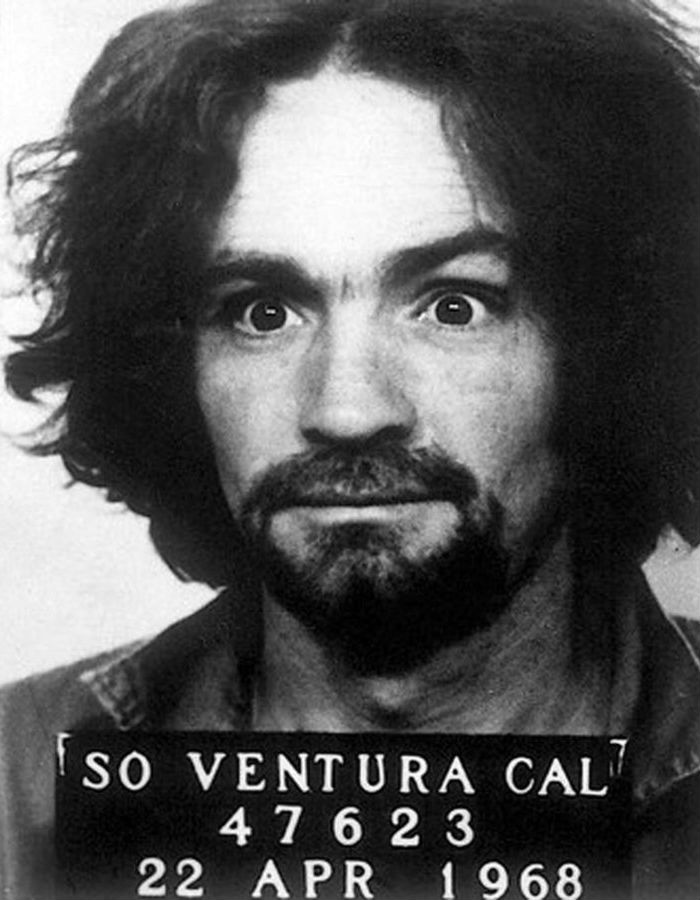 Charles Manson, 1968 / Photo Credit: California Section of Corrections and Rehabilitation
Source: https://www.contactmusic.com/charles-manson/news/music-and-murder-how-charles-manson-inspired-a-generation-of-musicians_6304841
0 Response to "Charles Manson Made Music and Art and Sold It"
Post a Comment