I Swiped Right and It Wasnt a Match but the Guy Came Up Again

"Kickoff they came …" is the poetic class of a 1946 post-war confessional prose by the German Lutheran pastor Martin Niemöller (1892–1984). It is about the cowardice of High german intellectuals and certain clergy—including, by his own admission, Niemöller himself—post-obit the Nazis' ascent to power and subsequent incremental purging of their chosen targets, group after group. Many variations and adaptations in the spirit of the original accept been published in the English language language. It deals with themes of persecution, guilt, repentance, and personal responsibility.
Text [edit]
The best-known versions of the confession in English language are the edited versions in poetic form that began circulating past the 1950s.[1] The U.s.a. Holocaust Memorial Museum quotes the post-obit text as i of the many poetic versions of the spoken language:[2] [3]
First they came for the socialists, and I did not speak out—
Because I was not a socialist.Then they came for the merchandise unionists, and I did not speak out—
Considering I was not a merchandise unionist.Then they came for the Jews, and I did not speak out—
Because I was not a Jew.So they came for me—and there was no one left to speak for me.
A longer version by the Holocaust Memorial Day Trust, a charity established by the British government, is as follows:[4]
First they came for the Communists
And I did not speak out
Because I was non a CommunistThen they came for the Socialists
And I did non speak out
Because I was not a SocialistThen they came for the merchandise unionists
And I did non speak out
Considering I was not a trade unionistThen they came for the Jews
And I did not speak out
Because I was non a JewThen they came for me
And there was no one left
To speak out for me
[edit]
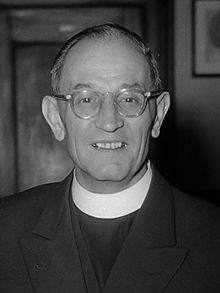
Martin Niemöller was a High german Lutheran pastor and theologian born in Lippstadt, Germany, in 1892. Niemöller was an anti-Communist and supported Adolf Hitler's rise to ability. But when, later on he came to power, Hitler insisted on the supremacy of the country over religion, Niemöller became disillusioned. He became the leader of a grouping of High german clergymen opposed to Hitler. In 1937 he was arrested and eventually confined in Sachsenhausen and Dachau. He was released in 1945 by the Allies. He connected his career in Frg as a clergyman and equally a leading phonation of penance and reconciliation for the German people after World War II.
Origin [edit]
Niemöller fabricated confession in his voice communication for the Confessing Church building in Frankfurt on half dozen January 1946, of which this is a fractional translation:[1]
... the people who were put in the camps then were Communists. Who cared about them? We knew it, information technology was printed in the newspapers. Who raised their voice, maybe the Confessing Church? Nosotros thought: Communists, those opponents of religion, those enemies of Christians—"should I exist my brother's keeper?"
So they got rid of the sick, the so-called incurables. I remember a conversation I had with a person who claimed to be a Christian. He said: Perchance it's right, these incurably sick people merely cost the state coin, they are merely a burden to themselves and to others. Isn't it all-time for all concerned if they are taken out of the middle [of society]? Only and so did the church as such take note.
So we started talking, until our voices were again silenced in public. Can nosotros say, nosotros aren't guilty/responsible?
The persecution of the Jews, the manner we treated the occupied countries, or the things in Greece, in Poland, in Czechoslovakia or in Holland, that were written in the newspapers. … I believe, nosotros Confessing-Church-Christians have every reason to say: mea culpa, mea culpa! We can talk ourselves out of it with the excuse that it would have cost me my head if I had spoken out.
We preferred to keep silent. Nosotros are certainly non without guilt/fault, and I ask myself once again and again, what would have happened, if in the year 1933 or 1934—at that place must have been a possibility—fourteen,000 Protestant pastors and all Protestant communities in Germany had defended the truth until their deaths? If nosotros had said back then, information technology is not correct when Hermann Göring but puts 100,000 Communists in the concentration camps, in gild to let them die. I can imagine that maybe xxx,000 to 40,000 Protestant Christians would have had their heads cut off, only I can also imagine that we would have rescued 30–twoscore,000 million [sic] people, because that is what it is costing us now.
This speech was translated and published in English in 1947, but was later retracted when it was alleged that Niemöller was an early on supporter of the Nazis.[v] The "sick, the so-called incurables" were killed in the euthanasia plan "Aktion T4". A 1955 version of the speech, mentioned in an interview of a German professor quoting Niemöller, lists Communists, socialists, schools, Jews, the press, and the Church. An American version delivered past a congressman in 1968 includes industrialists, who were simply persecuted by the Nazis on an individual basis, and omits Communists.
Niemöller is quoted as having used many versions of the text during his career, only evidence identified by professor Harold Marcuse at the University of California Santa Barbara indicates that the United States Holocaust Memorial Museum version is inaccurate because Niemöller frequently used the give-and-take "communists" and not "socialists."[1] The substitution of "socialists" for "communists" is an effect of anti-communism, and most common in the version that has proliferated in the United States. According to Harold Marcuse, "Niemöller's original argument was premised on naming groups he and his audition would instinctively not care about. The omission of Communists in Washington, and of Jews in Germany, distorts that significant and should be corrected."[1]
In 1976, Niemöller gave the post-obit answer in response to an interview question asking about the origins of the poem.[one] The Martin-Niemöller-Stiftung ("Martin Niemöller Foundation") considers this the "classical" version of the speech:
In that location were no minutes or copy of what I said, and it may be that I formulated information technology differently. But the thought was anyhow: The Communists, we even so permit that happen calmly; and the trade unions, we also allow that happen; and we fifty-fifty let the Social Democrats happen. All of that was not our affair.[half dozen]
Part in Nazi Germany [edit]
Like most Protestant pastors, Niemöller was a national conservative, and openly supported the conservative opponents of the Weimar Republic. He thus welcomed Hitler's accession to ability in 1933, believing that it would bring a national revival. By the autumn of 1934, Niemöller joined other Lutheran and Protestant churchmen such as Karl Barth and Dietrich Bonhoeffer in founding the Confessional Church, a Protestant group that opposed the Nazification of the German Protestant churches.
Still in 1935, Niemöller fabricated pejorative remarks nearly Jews of religion while protecting—in his ain church building—those of Jewish descent who had been baptised merely were persecuted by the Nazis due to their racial heritage. In ane sermon in 1935, he remarked: "What is the reason for [their] obvious punishment, which has lasted for thousands of years? Beloved brethren, the reason is easily given: the Jews brought the Christ of God to the cross!"[vii]
In 1936, however, he incomparably opposed the Nazis' "Aryan Paragraph". Niemöller signed the petition of a group of Protestant churchmen which sharply criticized Nazi policies and alleged the Aryan Paragraph incompatible with the Christian virtue of charity. The Nazi regime reacted with mass arrests and charges against almost 800 pastors and ecclesiastical lawyers.[eight]
Author and Nobel Prize laureate Thomas Mann published Niemöller's sermons in the The states and praised his bravery.
Usage [edit]

A US Navy chaplain reads an excerpt of Niemöller'southward poem during a Holocaust Days of Remembrance observance service in Pearl Harbor; 27 April 2009
At the The states Holocaust Memorial Museum in Washington, D.C., the quotation is on display, the museum website has a give-and-take of the history of the quotation.[9]
A version of the poem is on brandish at the Holocaust memorial Yad Vashem in Jerusalem. The verse form is also presented at the Virginia Holocaust Museum in Richmond, Virginia, the New England Holocaust Memorial in Boston, Massachusetts, the Florida Holocaust Museum in Saint petersburg, Florida, and the Illinois Holocaust Museum and Education Heart in Skokie, Illinois.
See also [edit]
- And Then They Came for Me
- Boiling frog
- Creeping normality
- Democratic backsliding
- The Hangman
- If You Requite a Mouse a Cookie
- Pes-in-the-door technique
- Night of the Long Knives
- Non My Business
- Political apathy
- Glace slope
- Sorites paradox
- Then They Came for Me: A Family's Story of Dear, Captivity, and Survival
References [edit]
Notes
- ^ a b c d e Marcuse, Harold. "Martin Niemöller's famous confession: "Get-go they came for the Communists ... "". Academy of California at Santa Barbara.
- ^ "Martin Niemöller: "First they came for the Socialists..."". Holocaust Encyclopedia. United states of america Holocaust Memorial Museum. Retrieved 25 July 2018.
- ^ "Martin Niemöller: "First they came for the Socialists..."". Holocaust Encyclopedia. Us Holocaust Memorial Museum. Archived from the original on 23 July 2018. Retrieved 25 July 2018. This is a unlike and older article which contains more complete photographs than the new version.
- ^ First they came - By Pastor Martin Niemoller, Holocaust Memorial 24-hour interval Trust
- ^ Marcuse, Harold; Niemöller, Martin. "Of Guilt and Hope". University of California at Santa Barbara.
- ^ Niemöller, Martin. "Was sagte Niemöller wirklich?". Martin Niemöller Foundation.
- ^ The text of this sermon, in English, is found in Martin Niemöller, Get-go Commandment, London, 1937, pp. 243–250.
- ^ LeMO. "Die Bekennende Kirche". Dhm.de. Retrieved xix June 2014.
- ^ Niemöller, Martin. "First they came for the Socialists…". United States Holocaust Memorial Museum . Retrieved 5 February 2011.
Further reading [edit]
- Baldwin, James (seven Jan 1971). "Open up Letter of the alphabet to my Sister, Angela Davis". New York Review of Books. Quotation: "If they come for me in the morn, they will come up for you in the nighttime."
- Davis, Angela Y. (1971). If They Come up in the Forenoon: Voices of Resistance . The Third Printing. ISBN9780893880224.
- Stein, Leo (2003), They Came for Niemoeller: The Nazi War Against Faith, Gretna, Louisiana: Pelican Publishing Co, ISBNi-58980-063-X , retrieved 22 August 2012 First published 1942 by Fleming H. Revell Co.
{{citation}}: CS1 maint: postscript (link)
External links [edit]
Source: https://en.wikipedia.org/wiki/First_they_came_...
0 Response to "I Swiped Right and It Wasnt a Match but the Guy Came Up Again"
Post a Comment