What 2 Systems Work Together to Help the Body Move?
Circulatory System
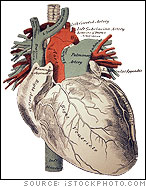
The circulatory organization is the torso's transport arrangement. It is fabricated upwardly of a group of organs that transport blood throughout the body. The heart pumps the claret and the arteries and veins transport it. Oxygen-rich claret leaves the left side of the heart and enters the biggest artery, chosen the aorta. The aorta branches into smaller arteries, which then co-operative into even smaller vessels that travel all over the body. When blood enters the smallest claret vessels, which are called capillaries, and are found in body tissue, it gives nutrients and oxygen to the cells and takes in carbon dioxide, water, and waste. The blood, which no longer contains oxygen and nutrients, and then goes back to the heart through veins. Veins carry waste material products away from cells and bring blood back to the heart , which pumps it to the lungs to pick upward oxygen and eliminate waste material carbon dioxide.
Digestive System
The digestive organization is made upwardly of organs that break down food into poly peptide, vitamins, minerals, carbohydrates, and fats, which the torso needs for energy, growth, and repair. After food is chewed and swallowed, it goes down the esophagus and enters the stomach, where it is further broken down by powerful stomach acids. From the tum the food travels into the pocket-size intestine. This is where your food is broken down into nutrients that tin enter the bloodstream through tiny pilus-similar projections. The excess food that the body doesn't need or can't digest is turned into waste material and is eliminated from the body.
Endocrine Arrangement
The endocrine system is made up of a group of glands that produce the trunk'southward long-distance messengers, or hormones. Hormones are chemicals that command body functions, such every bit metabolism, growth, and sexual development. The glands, which include the pituitary gland, thyroid gland, parathyroid glands, adrenal glands, thymus gland, pineal torso, pancreas, ovaries, and testes, release hormones directly into the bloodstream, which transports the hormones to organs and tissues throughout the body.
Immune System
The immune system is our torso's defence system against infections and diseases. Organs, tissues, cells, and cell products work together to answer to unsafe organisms (like viruses or bacteria) and substances that may enter the trunk from the environment. At that place are three types of response systems in the immune arrangement: the anatomic response, the inflammatory response, and the immune response.
- The anatomic response physically prevents threatening substances from inbound your body. Examples of the anatomic system include the mucous membranes and the skin. If substances do get past, the inflammatory response goes on attack.
- The inflammatory organisation works by excreting the invaders from your body. Sneezing, runny noses, and fever are examples of the inflammatory system at piece of work. Sometimes, even though you don't feel well while it's happening, your body is fighting affliction.
- When the inflammatory response fails, the immune response goes to work. This is the central part of the allowed system and is made upward of white blood cells, which fight infection by gobbling up antigens. About a quarter of white blood cells, chosen the lymphocytes, drift to the lymph nodes and produce antibodies, which fight disease.
Lymphatic Organisation
The lymphatic organization is also a defense force system for the body. It filters out organisms that cause affliction, produces white claret cells, and generates disease-fighting antibodies. It also distributes fluids and nutrients in the torso and drains backlog fluids and poly peptide so that tissues exercise not smashing. The lymphatic arrangement is fabricated up of a network of vessels that help broadcast body fluids. These vessels carry excess fluid abroad from the spaces between tissues and organs and return it to the bloodstream.
Muscular System
The muscular organisation is made up of tissues that work with the skeletal arrangement to control movement of the trunk. Some muscles?similar the ones in your arms and legs?are voluntary, meaning that yous decide when to move them. Other muscles, like the ones in your stomach, middle, intestines and other organs, are involuntary. This means that they are controlled automatically by the nervous system and hormones?you often don't even realize they're at piece of work.
The body is made up of three types of muscle tissue: skeletal, smooth and cardiac. Each of these has the ability to contract and expand, which allows the trunk to motion and function. .
- Skeletal muscles assistance the body motility.
- Polish muscles, which are involuntary, are located inside organs, such as the stomach and intestines.
- Cardiac muscle is found only in the heart. Its motion is involuntary
Nervous System
The nervous arrangement is made upwards of the encephalon, the spinal cord, and nerves. Ane of the most important systems in your body, the nervous system is your body'south control system. Information technology sends, receives, and processes nerve impulses throughout the body. These nerve impulses tell your muscles and organs what to practise and how to answer to the surroundings. In that location are 3 parts of your nervous system that work together: the fundamental nervous system, the peripheral nervous system, and the autonomic nervous system.
- The primal nervous arrangement consists of the encephalon and spinal cord. It sends out nerve impulses and analyzes information from the sense organs, which tell your brain almost things yous run into, hear, smell, taste and feel.
- The peripheral nervous arrangement includes the craniospinal nerves that branch off from the brain and the spinal cord. It carries the nerve impulses from the central nervous system to the muscles and glands.
- The autonomic nervous organization regulates involuntary action, such as heart beat and digestion.
Reproductive Organization
The reproductive system allows humans to produce children. Sperm from the male fertilizes the female person's egg, or ovum, in the fallopian tube. The fertilized egg travels from the fallopian tube to the uterus, where the fetus develops over a period of nine months.
Respiratory Arrangement
The respiratory system brings air into the body and removes carbon dioxide. It includes the nose, trachea, and lungs. When you exhale in, air enters your olfactory organ or rima oris and goes down a long tube called the trachea. The trachea branches into 2 bronchial tubes, or primary bronchi, which get to the lungs. The primary bronchi branch off into fifty-fifty smaller bronchial tubes, or bronchioles. The bronchioles cease in the alveoli, or air sacs. Oxygen follows this path and passes through the walls of the air sacs and claret vessels and enters the claret stream. At the aforementioned time, carbon dioxide passes into the lungs and is exhaled.
Skeletal Arrangement
The skeletal organization is made up of bones, ligaments and tendons. It shapes the torso and protects organs. The skeletal organization works with the muscular arrangement to help the body move. Marrow, which is soft, fatty tissue that produces red blood cells, many white blood cells, and other allowed organization cells, is found inside bones.
Urinary Organization
The urinary organisation eliminates waste from the body, in the form of urine. The kidneys remove waste from the blood. The waste combines with h2o to form urine. From the kidneys, urine travels downward two thin tubes called ureters to the bladder. When the bladder is full, urine is discharged through the urethra.
Source: https://www.factmonster.com/math-science/biology/human-body/your-bodys-systems
0 Response to "What 2 Systems Work Together to Help the Body Move?"
Post a Comment